
10 Most Disaster Affected Countries
The world has frequent, devastating natural disasters. These countries are hit the worst.
NGO & AID NEWS
By Geno Teofilo, Head Writer
2/28/20263 min read
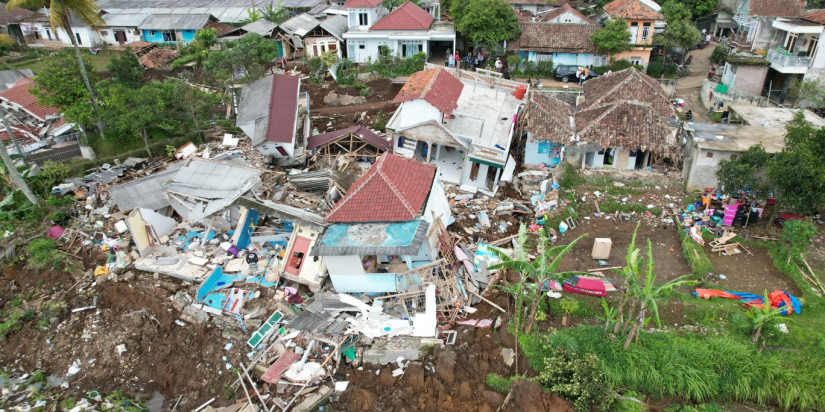
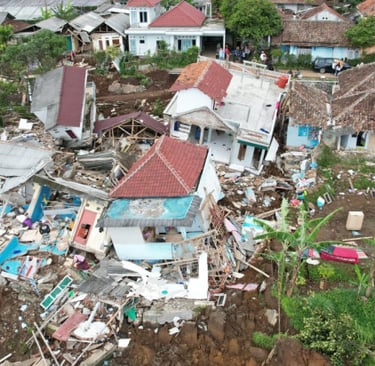
Photo: Cianjur earthquake damage in Indonesia. Source: National Agency for Disaster Countermeasure
As aid workers, our NGOs often respond to disasters overseas. We certainly notice that some countries seem to get struck by natural disasters repeatedly, while others rarely do.
But what do the statistics say?
There are many organizations that do regular studies on disaster statistics globally, and they measure many different facets of natural disasters. Here are 4 of the most reputable: 1) WorldRiskIndex 2025 (Natural Events Focus). 2) INFORM Natural Hazard Index 2026. 3) Germanwatch (Global Climate Risk Index 2026). 4) United Nations Office for Disaster Risk Reduction – Emergency Events Database (Total Disaster Count 2024 – 2025).
Getting to the point, with the help of AI, I’ve taken information from 4 of these organizations, and come up with a combined list. A technical term for it, is an “Aggregated Disaster Risk Index”. The measuring and averaging has balanced disaster frequency, intensity, and vulnerability. I’ve not included “man made disasters”, such as conflicts, or industrial accidents. These are natural disasters alone.
Without further ado, here’s the list of the 10 Most Disaster Affected Countries:
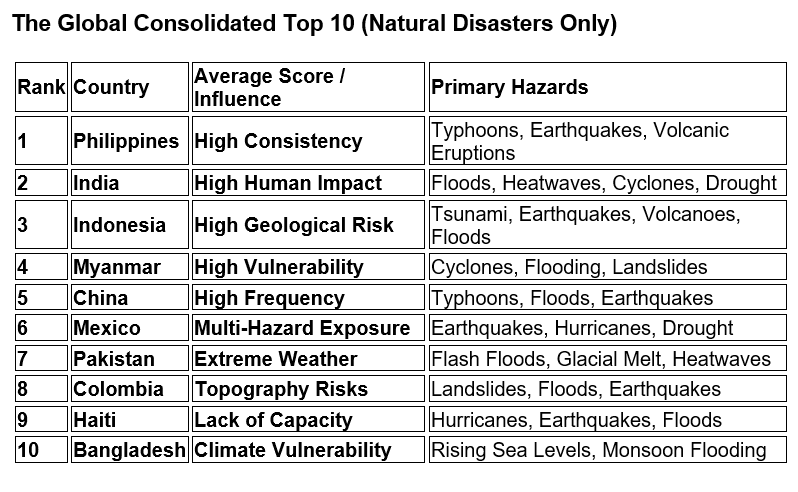
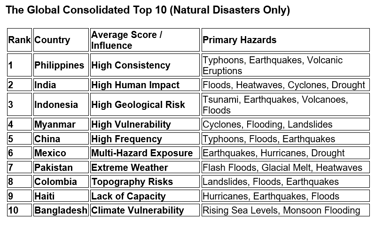
Some points on the above:
Many Americans and Japanese know that numerically, their countries are certainly high on this list. While it’s true that their annual average number of natural disasters is more than many of the above, their high wealth, infrastructure and response capacity prevent most of their disasters from becoming humanitarian catastrophes.
On a personal note, USA does get hit by disasters very often. In my view it's due to it's size, and varied topography. Before I worked for NGOs, I volunteered for the Red Cross. During a 4 year period, I volunteered for several hurricanes, several tornadoes, a pair of wildfires, and a flood. And that was only in 1 region of the country.
4 of the worst affected countries on this list, are in the “Ring Of Fire”. This is the most disaster prone area on earth. For the Philippines, Indonesia, Mexico and Colombia, these are countries bordering the submerged “Pacific Plate”, which is part of the Ring of Fire. You may have learned about “Plate Tectonics” in school; the shifting Pacific Plates movement collides with its surrounding plates, regularly causing earthquakes, tsunamis, flooding, and volcanic eruptions. (China is technically not in the Ring of Fire, although it is affected by it.)
I can also attest to the fact that the Philippines is the most affected. Having done NGO communications there for 2 years, I was surprised at how often their islands are struck by typhoons. No other country on earth is hit by so many damaging typhoons (or hurricanes) so frequently. Plus, there was an old volcano called Taal Lake, with a tourist site I visited. It's the biggest volcanic crater I had ever seen. 3 years after I left, tragically, it erupted. Dozens of people died. Over 400,000 were displaced.
Another important point to be made, is on populations and poverty. 5 of these countries are in the top 10 for populations. (India, China, Indonesia, Pakistan and Bangladesh.) Most of these have high numbers of people living in poverty. Combine high population density and poverty, and it turns natural disasters into humanitarian catastrophes.
Why? A coworker I knew who worked in the Red Cross, put it this way: 'When there are rising populations, and all the good land is taken, and there’s no affordable housing available for poor families, then they end up moving onto disaster prone land, or live in unsafe (unstable) housing. This makes it more dangerous for them and their families when a natural disaster occurs.'
So what is the solution?
The single top solution, to prevent future deaths from natural disasters, would be to build a massive number of safely built, affordable, decent housing units, for low – income families in areas less prone to natural disasters.
But that’s a post for another day.